
by Eric Ford | Nov 2, 2023 | Exoplanet & Brown Dwarf Surveys, Orbital Dynamics, Press Coverage, Statistical Methodology & Data Analysis
New analysis of observational data from NASA’s Kepler space telescope catalogs planetary properties; informs climate of planets Most near-Earth-sized planets travel around their host stars on nearly circular orbits, and the more small planets orbiting close to a star,...

by Eric Ford | Dec 1, 2020 | Exoplanet & Brown Dwarf Surveys, Featured, News, Publications, Star & Planet Formation, Statistical Methodology & Data Analysis
Statistical model may help unravel the mystery of apparently single-planet systems and aid exoplanet-seeking missions Data from the Kepler space telescope, launched more than a decade ago, is still helping astronomers who study planets outside of our own solar system...
by Eric Ford | Aug 14, 2019 | Exoplanet & Brown Dwarf Surveys, Featured, Statistical Methodology & Data Analysis
A new study provides the most accurate estimate of the frequency that planets that are similar to Earth in size and in distance from their host star occur around stars similar to our Sun. Knowing the rate that these potentially habitable planets occur will be...

by Eric Ford | Aug 14, 2017 | Exoplanet & Brown Dwarf Surveys, Instrumentation, Statistical Methodology & Data Analysis
Penn State hosted the Third Extremely Precise Radial Velocities workshop August 14-17, 2017. For more details, see the meeting website.
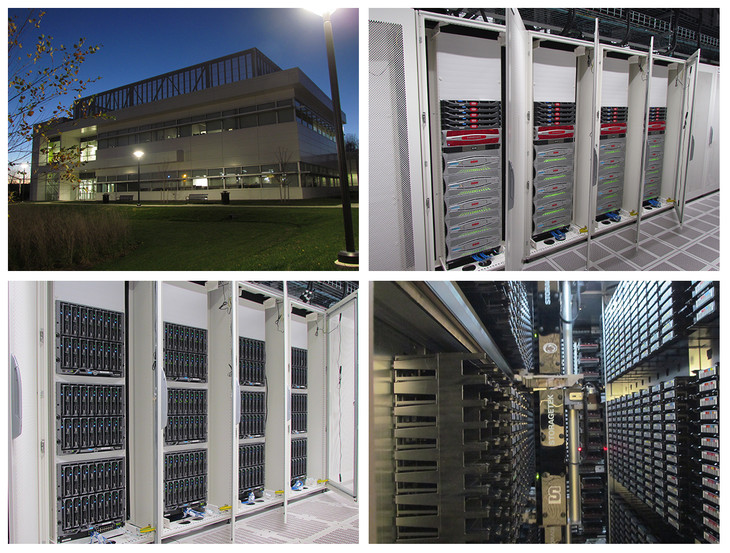
by Eric Ford | Feb 21, 2017 | Awards & Honors, Instrumentation, News, Research, Star & Planet Formation, Statistical Methodology & Data Analysis
National Science Foundation funds supercomputer cluster at Penn State February 21, 2017 UNIVERSITY PARK, Pa. — The Penn State Cyber-Laboratory for Astronomy, Materials, and Physics (CyberLAMP) is acquiring a high-performance computer cluster that will facilitate...

by neb149 | Jan 13, 2017 | Announcements, Featured, Instrumentation, Planetary Atmospheres & Interiors, Research, Statistical Methodology & Data Analysis
We are happy to announce the avaliability of PandExo, an online tool and python package for simulating observations of transiting exoplanets with a wide variety of instruments on the Hubble Space Telescope or the upcoming James Webb Space Telescope. PandExo uses...

